


Acoustic panels custom-made for businesses
In a professional work environment, acoustics directly determine how focused, productive, and comfortable your teams are while working. Poor acoustics lead to distractions, stress, fatigue, and reduced speech intelligibility. With custom


What Acoustic Panels Mean
for your organization
Acoustic panels absorb sound waves and reduce reverberation, so that voices sound clear and distracting background noise fades away. For most professional spaces, we aim for a reverberation time (RT60) between 0.5 and 0.8 seconds—the range where concentration, speech intelligibility, and well-being come together.
Scientific research confirms the impact. Recent research shows that irrelevant speech is the biggest source of acoustic disturbance in open-plan offices, and that well-designed acoustic interventions measurably improve cognitive performance, reduce stress, and enhance privacy. Acoustics, therefore, is not a minor detail, but a direct contributor to productivity and well-being.
Customization in materials, design, and performance
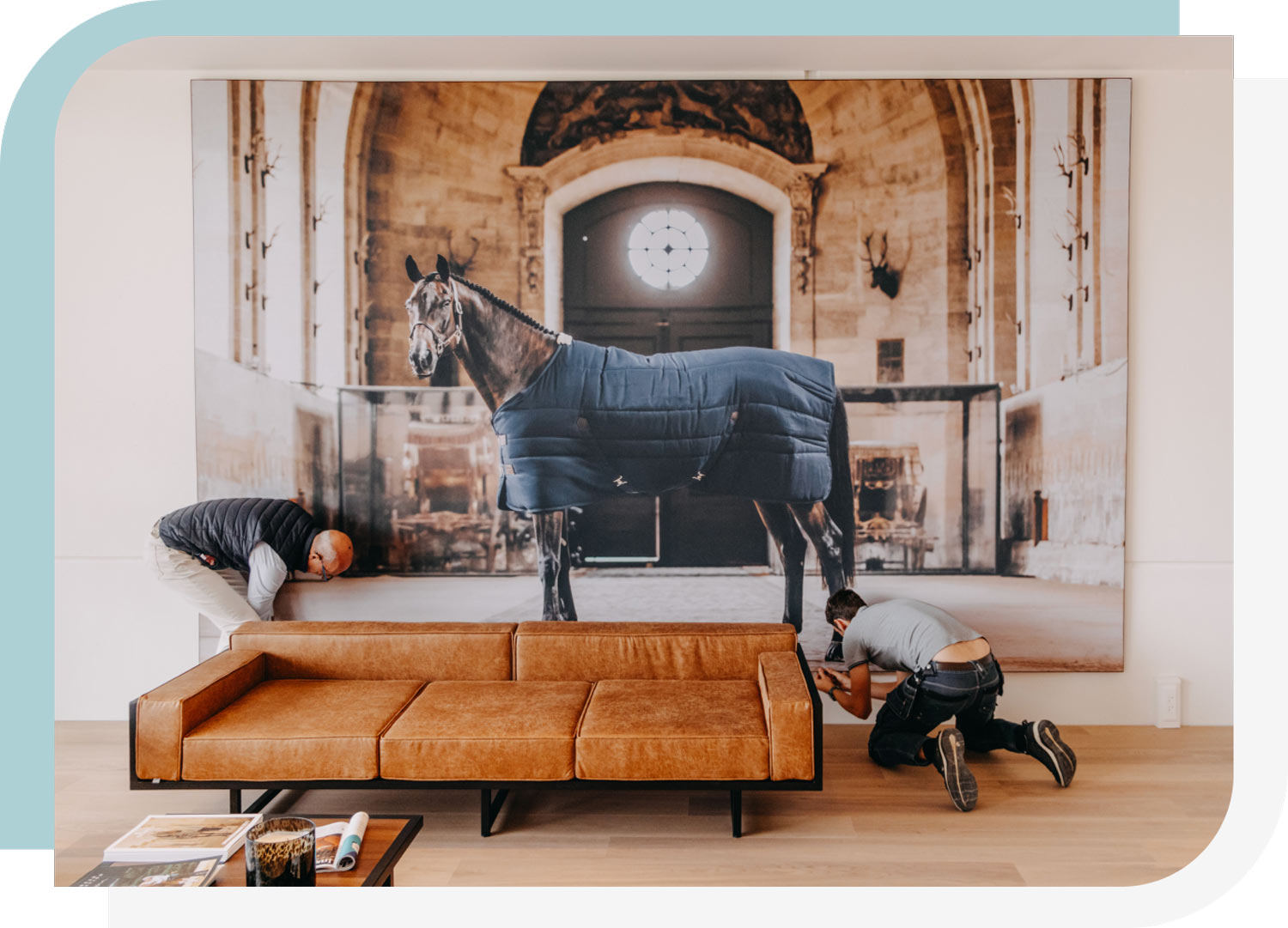
No two spaces are alike. That’s why every Form Design project begins with a building analysis and a thorough evaluation of the surfaces, volume, and usage. Based on this, we select panels made of nonwoven fabric, fabric, or perforated material—in solid colors, custom-printed patterns, or fully integrated wall systems. Aesthetics and acoustic efficiency reinforce each other. Every proposal complies with building codes and aligns with your organization’s architectural identity. For a thorough evaluation of your space, you can count on our acoustic consulting and project management.
What kinds of environments do we design for?
Our acoustic panels are used in a wide range of professional settings. In law firms, insurance agencies, and accounting firms, they ensure speech privacy during confidential conversations. In healthcare, they reduce stress for patients and care teams. In schools, they improve learning outcomes and vocal comfort. In the hospitality industry, they ensure a peaceful and high-quality guest experience. You can find an overview of all the sectors in which we operate on our sectors page.
Special attention is given to dynamic and hybrid offices. In activity-based work environments, concentration zones, collaboration spaces, and informal areas alternate. Acoustic panels are indispensable in these settings, often in combination with the meeting and phone booths from our partner Vergaderbox.be. Together, we provide an integrated solution for focus, confidentiality, and flexibility.
A picture is worth more
than 1,000 words
Ready for an
acoustic environment
that works?
Form Design analyzes your space, calculates the acoustic impact, and develops a customized proposal. You can count on a well-thought-out solution that aligns with your architecture, your teams, and your budget.
Some Frequently Asked Questions
What is the ideal reverberation time for an office?
For most professional work environments, the ideal RT60 is between 0.5 and 0.8 seconds. Within that range, voices remain intelligible without the room sounding echoey or dead.
Does Form Design perform acoustic measurements?
We generally do not perform traditional reverberation measurements. However, we do conduct a thorough building analysis and a floor area calculation, and we determine the acoustic impact based on volume, materials, and use.
What materials do you use?
Depending on the room’s function, aesthetic preferences, and desired absorption level, we use nonwoven fabric, fabric, or perforated panels. Each material offers its own advantages in terms of performance, appearance, and maintenance.
Are acoustic panels suitable for open-plan offices?
Absolutely. Acoustic panels are one of the most effective solutions for open-plan work environments, often used in combination with acoustic ceilings, baffles, and—for large areas—sound masking as well.
Do you work with architects and interior designers?
Yes. Form Design collaborates systematically with architects and contributes ideas early in the construction process, ensuring that acoustics are not an afterthought but an integral part of the design.
How long does an acoustic project take?
The turnaround time depends on the complexity and scale of the project. A typical B2B project goes through the analysis, proposal, production, and implementation phases in four to eight weeks.
